Week 1473 - The Democratization of Artificial Intelligence and What it Means for a Radiologist Like Me
The current state of AI has made it easy for people like me to embrace AI
Audio and Video at the end
Three years ago at the RSNA, Bijal and I were at dinner with a dear friend, now a radiology chair of one of the Chicago hospitals and I mentioned what a waste it was to attend the RSNA Courses on AI and Machine Learning. He said he had attended one of them and found the course useful to understand what ML was about. I retorted that that knowledge could be gained from one or two YouTube lectures and didn’t need a formal course where you paid quite a bit. Amateurs can’t really start learning how to create convolutional networks (CNNs) unless that is all they end up doing eventually.
My first brush with AI was in 2015, when after we installed the TwinBeam CT from Siemens, we started using the rib-view application that flattened out the ribs and numbered them and the vertebrae. It is a useful application to pick up and delineate fractures and other rib lesions and we were told that this was an AI application that had been created in-house by Siemens and then converted into a non-learning app for users.
In 2016, Hinton came up with his now-infamous prediction about radiologists being like the cartoon coyote that has already run off the edge of the cliff, but hasn’t yet looked down. It didn’t make sense then because ML was a mess. I remember trying to talk to Zebra Medical, an Israeli company, to deploy their version of AI for chest CT scans where they would look at aortic and pulmonary artery diameters, coronary calcium score and bone density for a dollar per scan and I thought it would be cool to give these as add-ons to the report. Zebra was difficult to deal with and at some point, they just stopped communicating.
We tried to deploy Qure.ai’s X-ray chest solution around that time, but it was buggy and my father, a senior radiologist, thought it just slowed him down. We tried to train Qure’s algorithm to look at lung fibrosis on CT scans and it failed. Balaji Ganeshan at that time was hawking TexRAD, a radiomics program, but he wasn’t willing to give it for free to try and while a few institutes like TMC did use it, it never led to anything because even today, radiomics is the blackest box there is and there is not one application that can be used practically…because the results are pretty much not replicable outside of the clinical study they came from.
In Feb 2020, we deployed CALIPER, a lung fibrosis and airway quantification tool from Imbio, which is now part of 4DMedical, but this is not really a deep learning tool. It is more a pattern recognition software built on older machine learning that has been in development for over 10 years and while we now use Claude to analyze the findings of the .csv file, the analysis itself is not really deep learning.
The RSNA before COVID, in 2019, saw over 130 companies on a separate floor, all trying to sell pretty much the same stuff - chest X-rays, lung nodule detection, breast lesion detection…and not one application was truly ready for clinical use. The RSNA in 2023 saw far fewer companies, many from 2019 long gone. One company still around is CARPL, run by Vidur Mahajan, who has built a marketplace for AI applications rather than the applications themselves and that market also seems to be struggling to deliver what it promised.
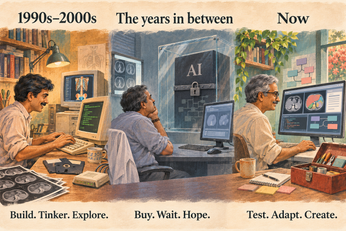
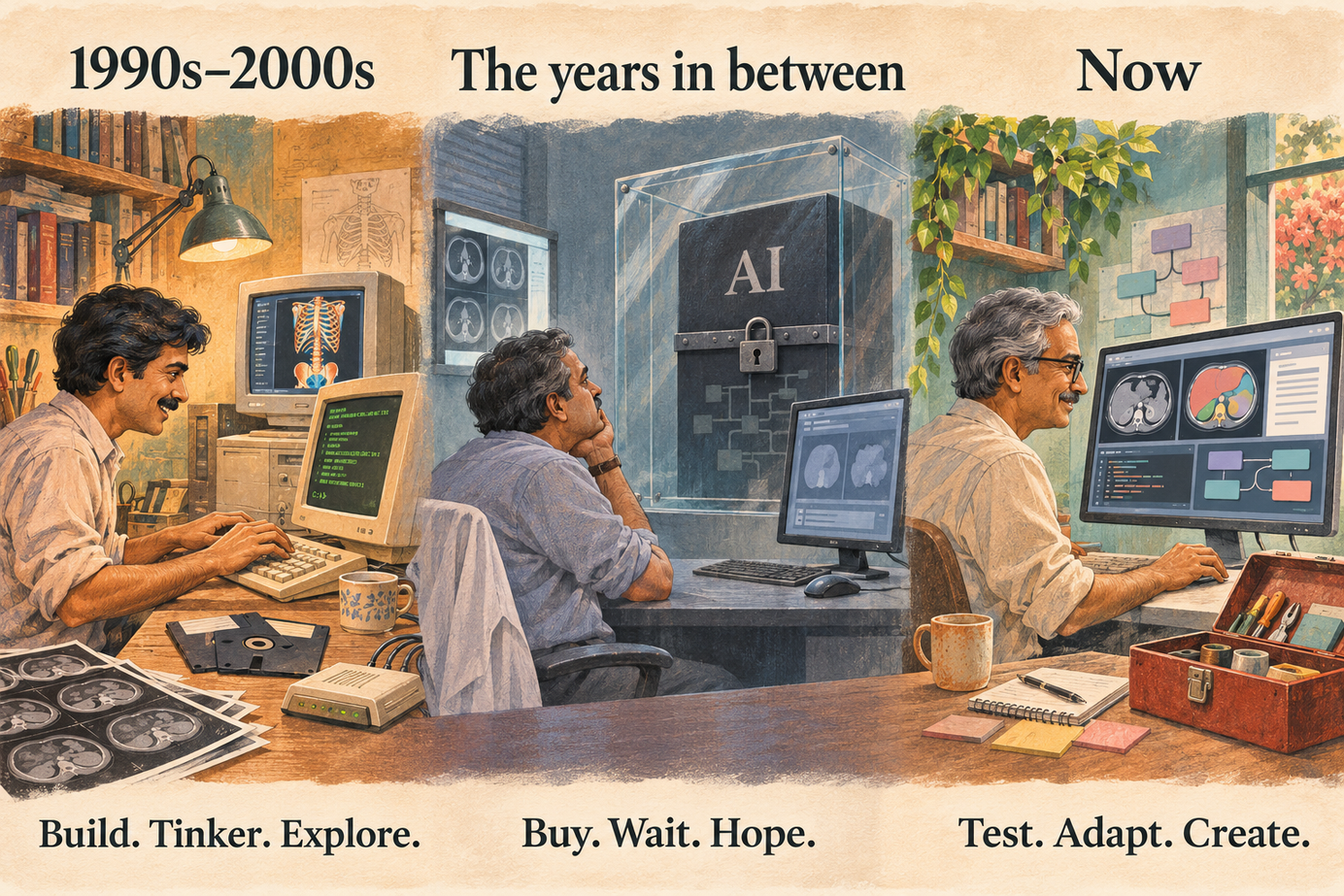
To me, it was a frustrating time because there was nothing I could really do to experiment with the softwares and applications. There were products I could buy or not buy, but none of them were things I could open up, test in my practice and change them or tinker with them to assimilate them into our workflow.
Because…
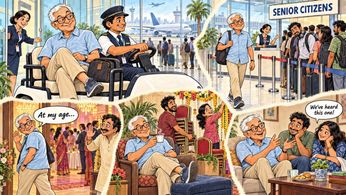
Way back in 1991, when I was first exposed to a 286 PC at the age of 26 for creating reports using WordStar in Bombay Hospital when I joined the CT scan department, I caught a tech bug that never went away. I keep talking about the three 30s of my life at atmasvasth.com. The first 30 was about learning, the second was about working hard and the third 30 now as a certified senior citizen in India is about figuring out how to maintain a long healthspan, within whatever lifespan I end up having. Similarly in medicine, radiology and computing, the first 30 years (in my case up to age 26) were about learning medicine without any computers, the next 30 saw the takeover of medicine and our lives by computers and the Internet and the next 30 seem to be about AI, whose end-point is impossible to gauge at this point in time.
In 1992, at the age of 27 years, I coded an electronic health record (EHR) solution using FoxPro with a compiler, distributed on 5 1/4” floppies. The company was called RadSoft and along with my sister Neha, we sold about 20-30 copies for Rs. 1500 each. I created this software for my father to use in the clinic because the person who we wanted to buy from quoted a then-what-we-thought was a fantastic sum of Rs. 10,000 - he was also a doctor, but I can’t remember his name. We stopped RadSoft because it was impossible to give customer support to people who had no clue how to even switch on computers, which basically were command line (MS-DOS) at the time.
In 1994, I went for a year to the US and that was the year of the Internet. I had an @ucsd.edu ID, then an AOL ID and used email and listservs all the time. The first month we were back, Bharat Online had full page ads in the TOI, but that never worked out. When Sharad Sanghi came back from the US and set up the VSNL backbone, we finally had some form of Internet, which we used with dial-up modems (2400 bps, then 9600 bps) and @vsnl.net.in IDs. Hotmail and then Gmail IDs came later.
In 1995, I put up a CT scanner in the old Hurkisondas Hospital and even though the DICOM standard had just been introduced, the AR.C Siemens CT scanner did not support it and we had no means to transfer or view DICOM images.
Which is why in 1996, when we set up the first teleradiology system in India as an answer to the problem of managing nights, we used a screen grabber software connected to a monitor, which in turn was connected to the Siemens monitor and the tech would click each head CT image, which we would screen grab and the jpgs (about 12-13 soft tissue and a similar number for bone windows) for a head CT would be then transferred using a protocol I don’t remember now over those modems. It would take half hour to do this, and I would then call the tech and dictate a 2 line report. It saved the trouble of having to go down to the hospital and my nights became better. We wrote that up too. I never however thought of monetizing this or creating a business out of it as Arjun Kalyanpur successfully did, because I just didn’t care about reporting for other people and just wanted to focus on my practice.
However, when we upgraded to the AR.Star spiral CT scanner in 1999, we were able to start using DesAcc’s DICOM send and retrieve software called Digital Jacket to send images to a 3D workstation we had created with the help of a company called AccuImage, whose COO and then CEO was Robert Taylor. In those days, it was a powerful 3D workstation run on 1MB dll files that would be updated every few months, which I would download and install. That is how we became among the first practices to create 3D images in color using volume rendering, though the first 3D images (and we wrote that up in the IJRI) were using surface rendering on the Siemens HiQ, at Bombay Hospital for pelvic fractures and craniostenosis.
By 1998 or 1999, I had met Ajit Menon and the Quantum Link guys and registered jankharia.com and since then have had my @jankharia.com ID…it’s now been 26-27 years with that ID….I know…I get a lot of spam. This website and the refindia.net website both were created around that time and have been alive since, though now the picture-this.in site is the one we use for the practice.
By 1999, I was scripting html code and had a writing site manfrommatunga.com. It was among the first blogs in India before the term blog became a word and I have since retired it, though you can find a whole lot of archived stuff at bhavinj.com or at the Internet Archives.
And so the years went by and with each new machine and scanner and workstation, we found interesting things to do. And I kept up with my tech knowledge. In 2015, after attending an RSNA course on 3D printing (now that was useful), I bought an expensive 3D printer…this flopped because in 6 months, because the price of 3D printers that could create medical models dropped drastically and we couldn’t sustain the project financially, though I think it is now time to start again.
So you can imagine my helplessness when I realized that there was just nothing I could do with AI and ML, except wait and hope that there would be applications that could be used or tinkered with…there was nothing I could get my hands into. Zilch. Nada.
At the 2023 RSNA, while I was at one of the booths, I ran across a gentleman who was talking about large language models (LLMs), for radiology image interpretation. While ChatGPT did launch in Nov 2022, I still hadn’t really used it as of 2023 and didn’t know much of what it was capable of.
But the LLMs changed everything and I have detailed that journey in multiple places. Looking back, this is where the third 30 I spoke of earlier began for me, though I did not see it that way at that time. Initially, ChatGPT was useful for querying medical issues or complex problems that were tough to use PubMed for, but once I started using MacWhisper, I was able to dictate to it and then paste a 95% accurate transcription into the EHR. Soon that morphed to using the iPhone for dictation (which means I had to create automations to make it go into DND mode, the moment I opened Voice Memos) and then when I moved to Claude, I could create templates and the whole dictation accuracy issue got sorted out. With the models becoming powerful, and then switching to Mac mini M4s everywhere, I could create schematics, use prior information for tables and comparisons and suddenly I was able to use AI for a whole lot of things, both personal and otherwise to change things. I am constantly experimenting with agents with quite some help now from my son Sach and figuring out how to use them in practice too.
TotalSegmentator for example is a wonderful example of AI that works with OsiriX MD, my primary interpretation software. It is a deep learning model, exactly the kind that amateurs like me can’t build, and I don’t need to (just as I never needed to learn how to build any of the softwares and apps I have used in the 2nd 30 years), but because a group in Basel built it, I can run it on my own scans and see for myself whether it works for me or not. Each time someone comes up with a new model on Hugging Face or GitHub, I am able to check it out, if there is a front end or by using python and the command line interface (CLI), which was how MS-DOS worked anyway, at the start of the 2nd 30s.
Since I wrote the first draft, Sach has now created a webapp that integrates totalsegmentator.com with other models like Cornerstone 3D for segmentation, viewing, annotation, etc. We are constantly experimenting with open source tools...I mention what I want and he puts it in the app for me to test and use.
As of today however, there still isn’t a single LLM, or model or application that can reliably interpret scans…they are getting there but not today and it is impossible to make predictions on how good they will be or when and what will be our status then. Where AI has completely changed the way we practice is in the non-image interpretation areas like dictation, reducing errors, templates, managing schedules and appointments, segmentation, tables, measurements and comparisons. And I am able to make sure that everything that goes into a report is checked against my own read and understanding and interpretation.
But then I own my practice and the scanner and for me it is about optimization. As long as I can do things by myself not be dependent on black box companies, it works for me. I also understand that this is easier for me than a radiologist employed in a hospital or practice with either no incentive to innovate or with hurdles placed by the organization with respect to the tech itself or purchasing access to apps and LLMs, but a lot can still be done on personal laptops with anonymized images to start with.
I am also aware that Claude and ChatGPT are by themselves black boxes made by a handful of large companies, far more opaque than anything Zebra or Qure or TexRAD ever sold. The difference is that I can use them on my own terms, test them on my own cases at little cost and walk away if something doesn’t work or pivot or try something new.
That’s democratization. Where people like me can use software or create apps without feeling lost in the black-boxes of ML and CNN, which were in the hands of a few people who were able to enchant a whole bunch of radiologists who couldn’t really figure out their capabilities, because they couldn’t really test them or work with them independently.
I shed no tears over the death of many of these companies and I love the fact that the future of AI in Radiology with vision and large language models, will be directed by users like us who will eventually decide what to use, what works and what doesn’t. While administrators currently are the ones trying to implement AI tools and AI companies are aggressively targeting them rather than radiologists, my prediction is that eventually it is the end-users like us who will dictate what will succeed or not.
Which brings me back to that dinner in Chicago. What radiologists have always needed is not a course on how to build a CNN but the ability to pick up a model someone else has built, run it on their own cases, and decide for themselves, whether it works for them or not…something that is now possible.
The Concept Explained
 Bhavin Jankharia

Atmasvasth
 Bhavin Jankharia

Bhavin's Writings Newsletter
Join the newsletter to receive the latest updates in your inbox.